 birth.hour
What a natal chart can and cannot tell you
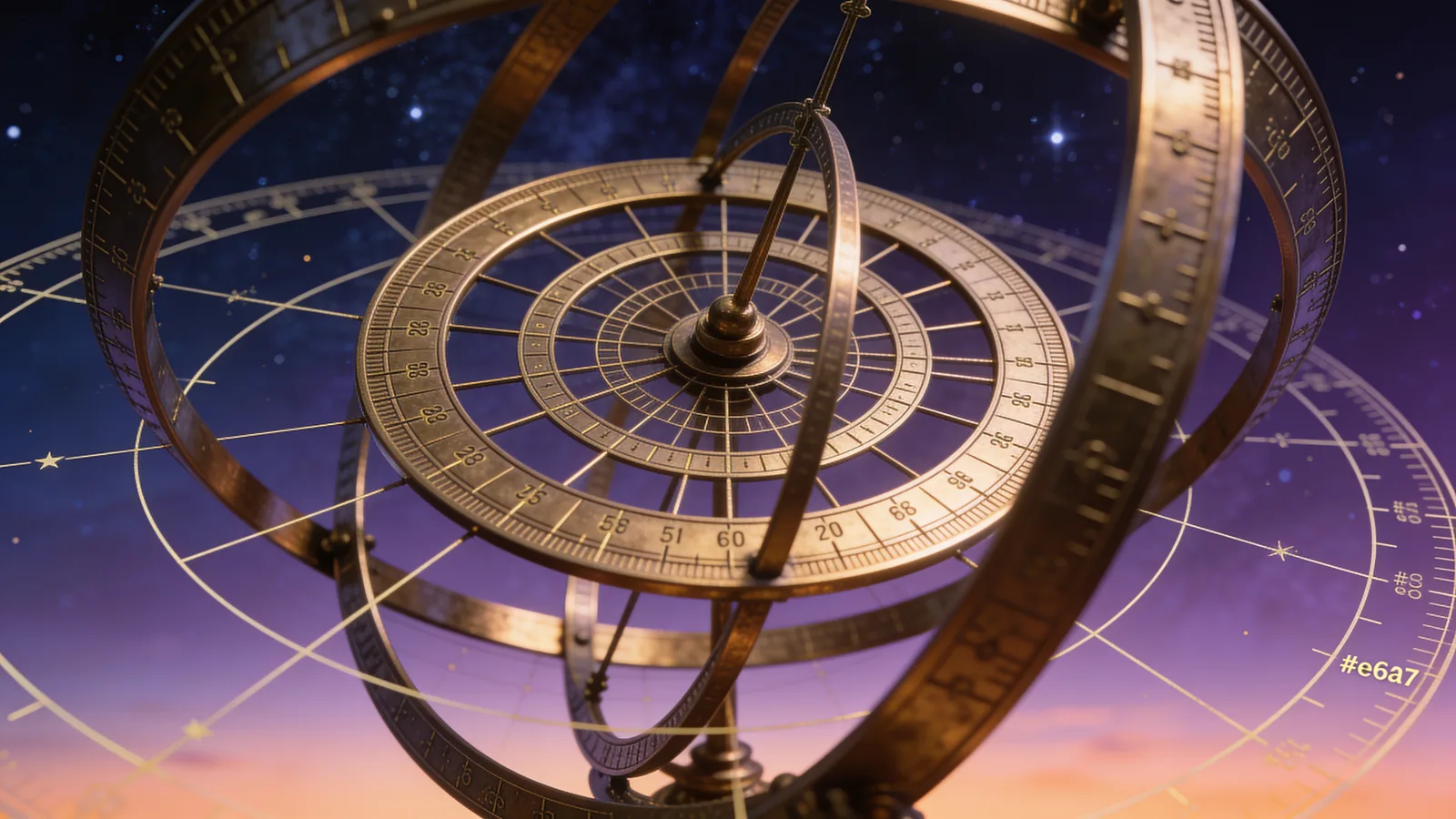
A natal chart is a diagram of the sky at the minute and place you were born: where the Sun, Moon and planets stood, which sign was rising on the eastern horizon, how the whole arrangement divides into houses.
The calculation behind it is real astronomy — the same ephemerides that observatories use. What the chart means is tradition, not measurement. Keeping those two layers distinct is the whole of our editorial policy, so here it is applied.
What is actually in a natal chart?
Strip away the interpretation and a chart is a short list of measured quantities:
- Longitudes. The position of each body along the 360° of the zodiac, which is divided into twelve signs of exactly 30° each. The Sun moves about 1° per day, the Moon between 12° and 15° per day (13.2° on average), Saturn takes 29.46 years to go round once, Jupiter 11.86 years.
- The Ascendant. The degree of the ecliptic rising on the eastern horizon at your birth minute. The whole circle rises in roughly 24 hours, which works out at about 1° every four minutes.
- The houses. Twelve sectors anchored to the horizon and the meridian, which is why they depend on your latitude and longitude, not just the date.
- The aspects. The angular distances between bodies: conjunction 0°, sextile 60°, square 90°, trine 120°, opposition 180°, each allowed a tolerance — an orb — of a few degrees.
- The Moon's phase. The Moon's distance from the Sun in degrees, cycling from new to new in 29.53 days.
None of that is a matter of belief. Any competent ephemeris will return the same numbers to within an arcsecond, and you can check ours against an almanac. Everything after the numbers is the interpretive layer, and it is a different kind of thing entirely.
What can a natal chart do?
Describe a temperament vocabulary. The tradition assigns themes to placements — a Capricorn Moon reads differently from a Cancer Moon — and thousands of years of use have made that vocabulary rich, precise and often uncomfortably recognisable. As a mirror for self-description, it is genuinely useful, the way a good novel's character is useful: not because it measured you, but because it gives you words.
Surface tensions worth naming. Aspects — the angles planets make to each other — encode the tradition's sense of what pulls against what. A chart read well often names a tension you already live with but hadn't put words to. That naming has value regardless of what you believe about its source.
Give you questions. The best use of a chart is not "who am I?" answered from outside, but a structured set of questions to sit with. Our reports end with questions on purpose.
What can a natal chart not do?
Predict events. Nothing in a natal chart says when you'll meet someone, change jobs, get sick or get lucky. Anyone selling you dates is selling you theatre.
Diagnose anything. A chart is not a personality test with clinical validity, and it is certainly not a medical or psychological instrument. It doesn't replace professionals, and we say so on every page.
Decide for you. "Should I take the job?" is not a chart question. A chart can, at best, sharpen how you think about the decision. The decision stays yours — which is better news than the alternative.
Prove itself. Astrology is a symbolic tradition, not a science, and we won't dress it up as one. The best-known controlled test — Shawn Carlson's double-blind study published in Nature in December 1985 (vol. 318, pp. 419–425) — found that astrologers could not match birth charts to personality profiles better than chance, and later replications have not overturned that. We read charts the way you read a myth or a tarot image: as a language for reflection, with a visible method and no claim to evidence.
Why does the birth time matter so much?
Because the fastest-moving thing in the chart is the horizon itself. Four minutes of clock time shifts the Ascendant by roughly one degree, so an error of half an hour moves it about 7° and can push a planet from the twelfth house into the first, or change the rising sign outright.
The signs also don't rise at equal speed. At the latitude of Lisbon (about 38.7°N), Pisces and Aries can clear the horizon in under an hour, while Cancer and Leo take closer to two and a half — the table of rising times shows the spread. And over a full day the Moon travels 12° to 15°, enough to change sign, so a chart cast for noon because the time is unknown carries real uncertainty in the Moon too.
If your certificate gives a rounded hour, or nothing at all, we set out what can still be read and what can't in why birth time matters and in our guide to finding your birth time.
Where do the schools disagree?
Often, and openly. The honest position is to name the fork rather than pretend there's a consensus:
- House systems. Placidus, Koch, Regiomontanus, Equal and Whole Sign all divide the same sky differently. A planet can sit in the twelfth house in one and the first in another. Whole Sign is the oldest, used in Hellenistic practice, and came back into wide use from the 1990s; Placidus has dominated Western printed astrology since the eighteenth century. There is no test that settles it.
- Which zodiac. Tropical (measured from the equinox) and sidereal (measured from the fixed stars) are currently about 24° apart because of precession, which drifts roughly 1° every 72 years. Most people's Sun sign differs by one sign between the two.
- Which bodies. Traditional practice uses seven visible bodies. Modern practice adds Uranus (discovered 1781), Neptune (1846), Pluto (1930), Chiron (1977) and often asteroids. Neither list is more "correct" than the other; they belong to different systems.
- Orbs. Some astrologers allow 10° for a conjunction, others 6°. That choice alone decides whether an aspect appears in your chart at all.
We use the tropical zodiac and show both Placidus and Whole Sign houses, and we tell you which is which rather than hiding the choice inside the output.
Where do we draw the line?
We calculate with real ephemerides, we show the method, and we write in plain language with no event predictions, no fear and no flattery. Where the tradition is unsure, we say so on the page instead of in a footnote.
If that sounds like your kind of astrology, start with the free calculator — your natal chart with Sun, Moon and Rising, in three lines. If you want the long version, the full natal chart report walks placement by placement, with the degrees shown and the interpretive claims flagged as interpretation.
Frequently asked questions
Do I need the exact minute of my birth?
For the Ascendant and the houses, yes, near enough: four minutes of error moves the rising degree by about 1°, and thirty minutes can change the rising sign. For the Sun, the Moon and most planets, an accurate date and a rough time are usually enough.
Is astrology science?
No. The astronomy behind the chart is measurable and checkable; the meanings are a symbolic tradition with a documented history, and controlled studies have not found predictive validity in them. We keep the two layers labelled.
Which house system do you use, and does it change the reading?
We show Placidus and Whole Sign side by side. It can change the reading — a planet near a house cusp may move sector — which is exactly why we display both instead of picking one silently. There is more in our guide to the houses.
Can a chart tell me when something will happen?
No. Transits and returns describe cycles with known durations — Saturn returns to its natal place at about 29.5 years, Mercury turns retrograde three or four times a year for roughly three weeks each time — but a cycle is a season, not an event with a date attached.
What if my birth certificate time is rounded to the hour?
Read the chart with the Ascendant treated as uncertain, or work in Whole Sign houses, which are more forgiving at the edges. Our birth time guide explains how to narrow it down from records rather than guesswork.
The reading that continues this article
Share this article
Notes from the sky, now and then
Leave an email and we'll send the occasional honest reading — never spam, unsubscribe any time. Your free chart is one click away too.